
Across modern construction, forestry, and agricultural machinery, the global adoption of EPA Tier 4 Final and EU Stage V diesel emission standards has dramatically altered the internal thermal environment of heavy equipment:
When standard hydraulic cylinders designed for mild 70°C environments operate in these hot enclosures, hydraulic fluid degrades at an exponential rate, and standard elastomer seals turn brittle and crumble within months.
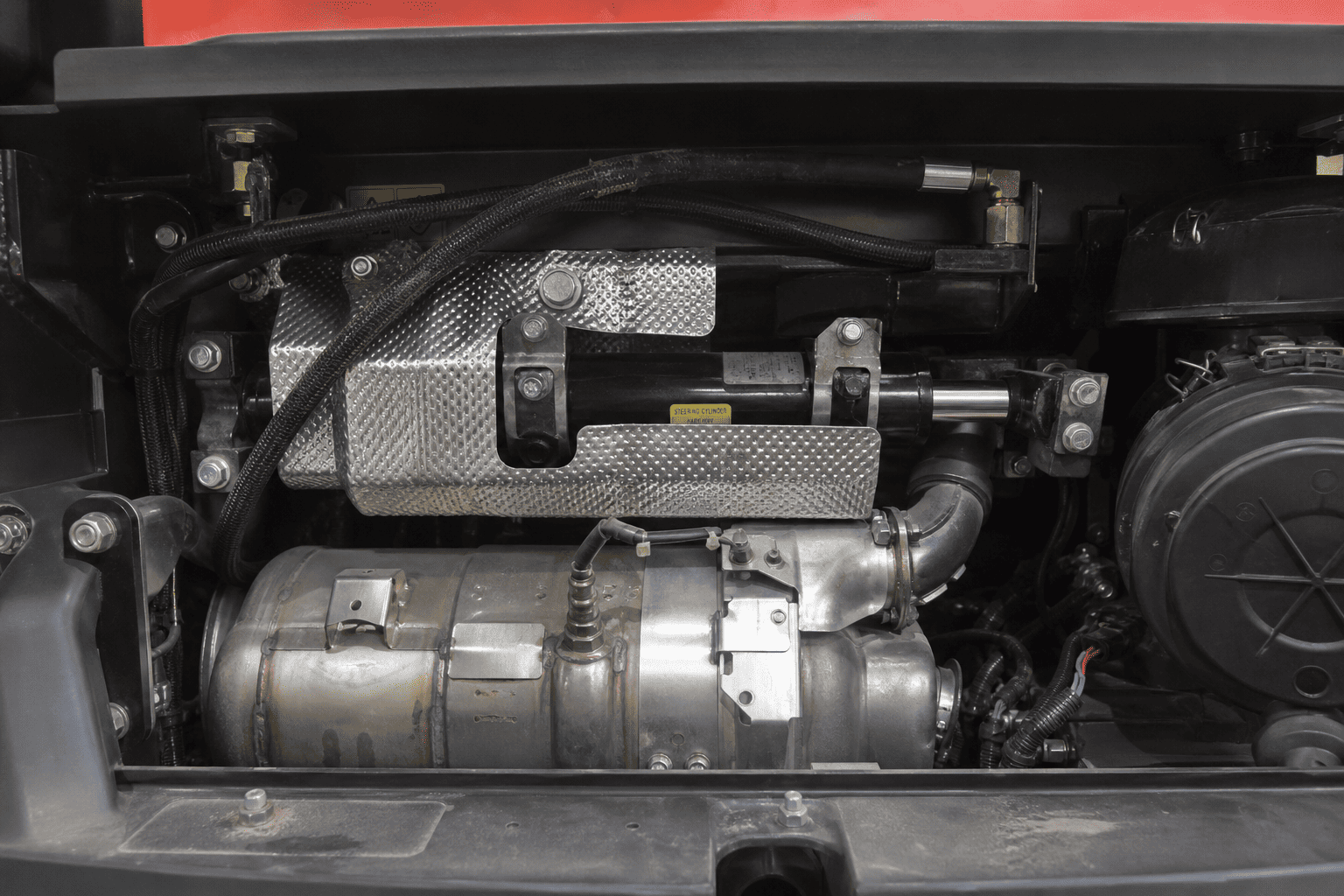
| Heat Source / Step | Description & Result |
|---|---|
| DPF / SCR Canister Active Regeneration | 600°C, Radiant Heat Convection in Tight Engine Bay |
| Ambient Engine Bay Air Temperature | 110°C–130°C |
| Heat Transfer Path | Direct Heat Soak into Cylinder Barrel & Fluid |
| Hydraulic Cylinder Oil | Exceeds 95°C Continuous |
| Impact on Standard Seals | Polyurethane / Nitrile Seals Harden & Extrude |
Hydraulic oil does not simply lose viscosity when heated—it undergoes destructive chemical decomposition governed by the Arrhenius rate equation:
1.Doubling Oxidation Rate: For every 10°C increase in fluid operating temperature above 60°C, the oxidation rate of standard mineral hydraulic oil doubles.
2.Varnish & Sludge Deposition: Thermal shearing breaks long-chain petroleum molecules into volatile acids, polymeric sludge, and hard lacquer varnish. This varnish coats internal cylinder bore surfaces, increasing frictional drag and scoring piston seals.
3.Depletion of Anti-Wear Additives: Zinc dialkyldithiophosphate (ZDDP) and anti-foam additives break down rapidly when bulk oil temperatures exceed 85°C, leaving metal-on-metal sliding surfaces unprotected against adhesive galling.
| Bulk Oil Temperature | Outcome |
|---|---|
| 60°C | Expected Fluid Life: ~4,000 to 5,000 Hours (Baseline) |
| 70°C | Expected Fluid Life: ~2,000 to 2,500 Hours (50% Loss) |
| 80°C | Expected Fluid Life: ~1,000 to 1,250 Hours (75% Loss) |
| 90°C+ | Severe Varnish, Sludge Formation & Rapid Seal Cracking |
When standard 95 Shore A Polyurethane (PU) or standard Nitrile (NBR) seals are subjected to continuous temperatures above 80°C, they suffer rapid physical degradation:
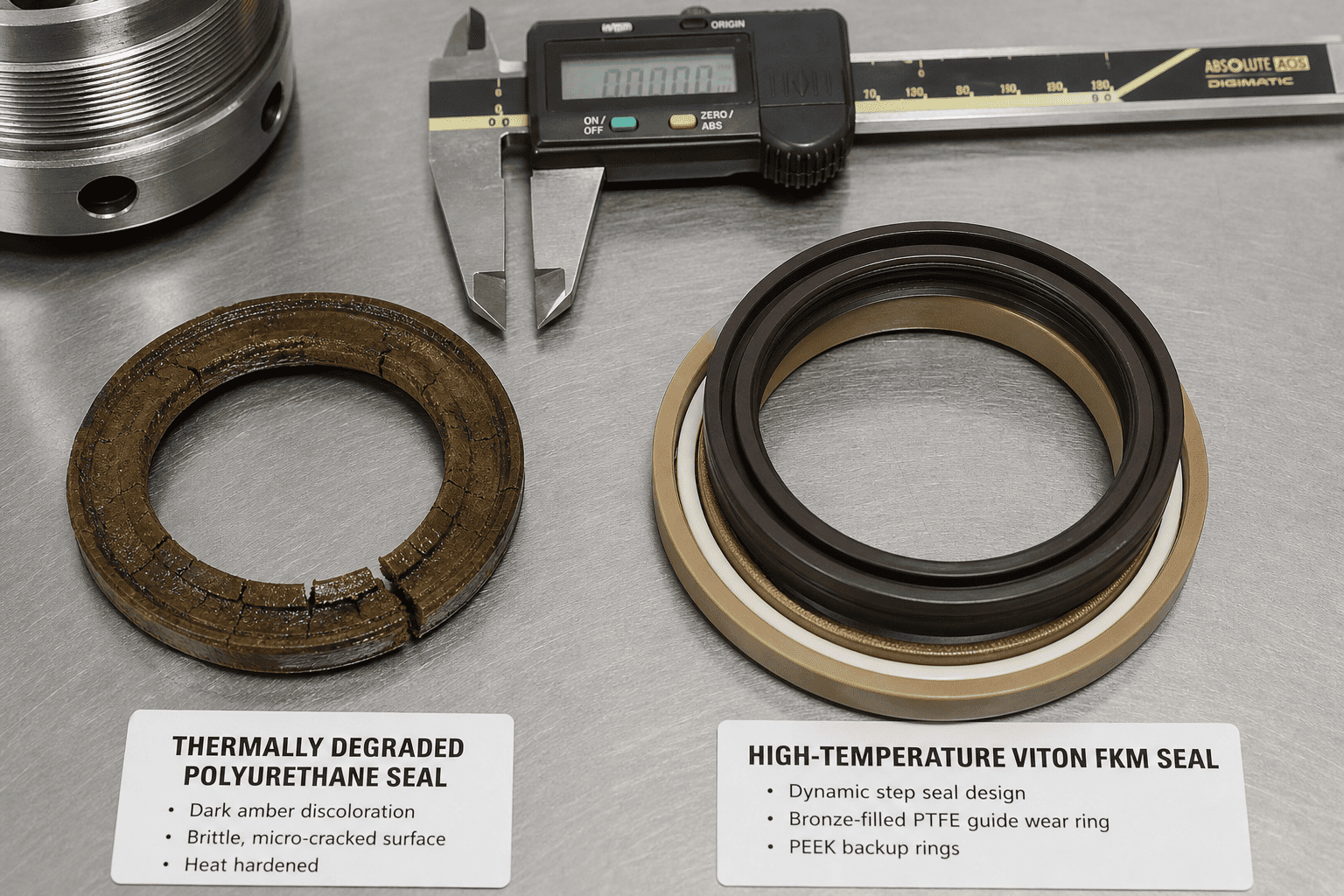
Fleet maintenance supervisors should inspect high-heat hydraulic circuits using this practical diagnostic protocol:
| Visual & Physical Symptom | Root Thermal Cause | Recommended Corrective Action |
|---|---|---|
| Dark, Burnt Smell in Hydraulic Fluid | Bulk oil thermal breakdown & additive depletion | Drain fluid, flush system, replace filters, clean oil cooler cores |
| Glass-Like Hardening of Rod Wiper Lip | Extreme radiant heat from nearby DPF/exhaust | Retrofit with FKM or HNBR high-temperature wiper seal |
| Glazed Brown Varnish on Chrome Rod | Polymerized oil varnish baking onto hot chrome | Clean rod with solvent, inspect cooler airflow, upgrade to synthetic oil |
| Cylinder Drift Only When Cold | Permanent compression set loss in piston seals | Rebuild cylinder with energized bronze-PTFE piston seals |
| Pitted or Scored Piston Guide Bands | Thermal breakdown of standard nylon wear rings | Upgrade to high-temp phenolic composite or bronze guide rings |
Are you engineering compact Tier 4 Final / Stage V equipment or dealing with recurring seal failures on hot exhaust-adjacent cylinders?
Partner with HCIC for custom-engineered High-Temperature Hydraulic Cylinder Assemblies: