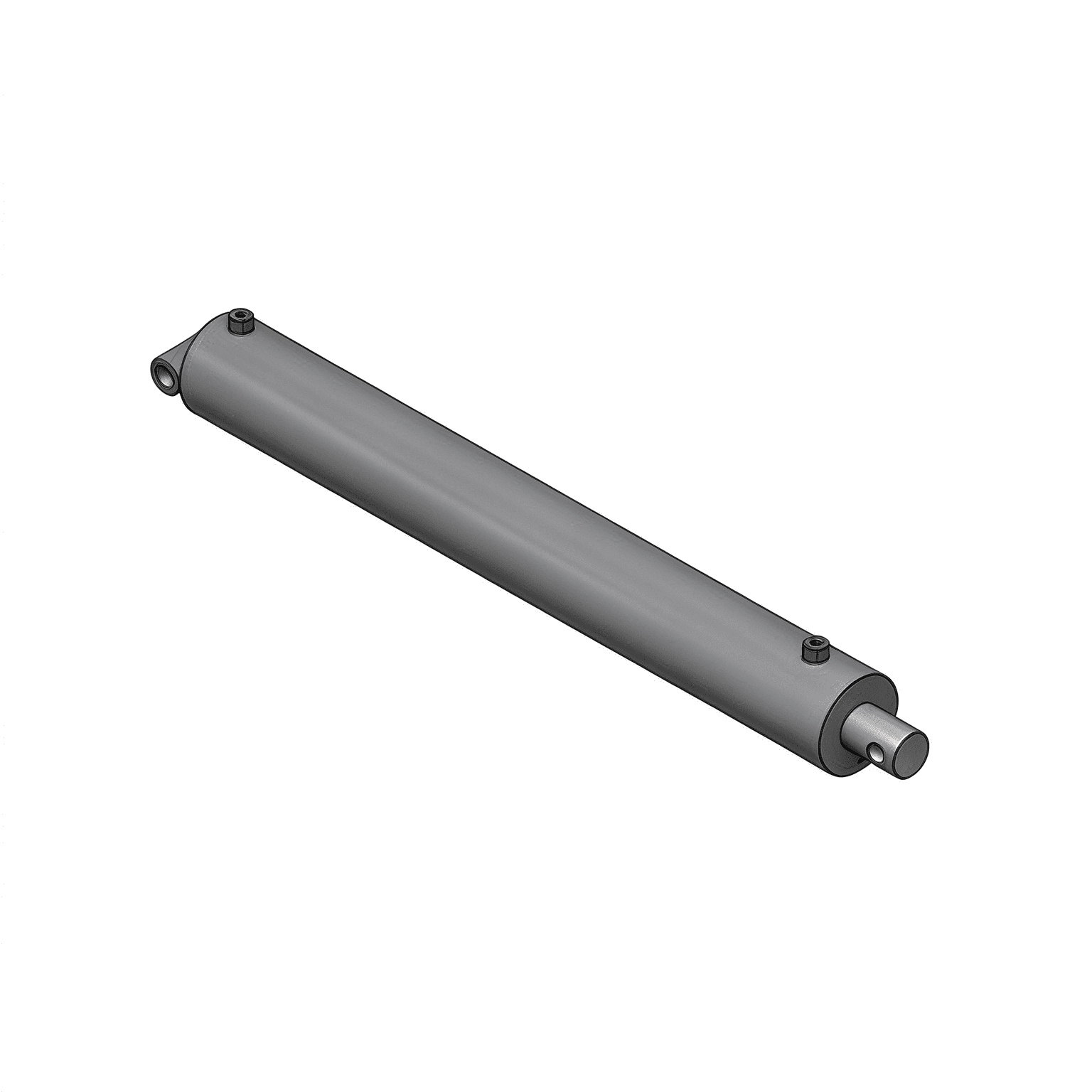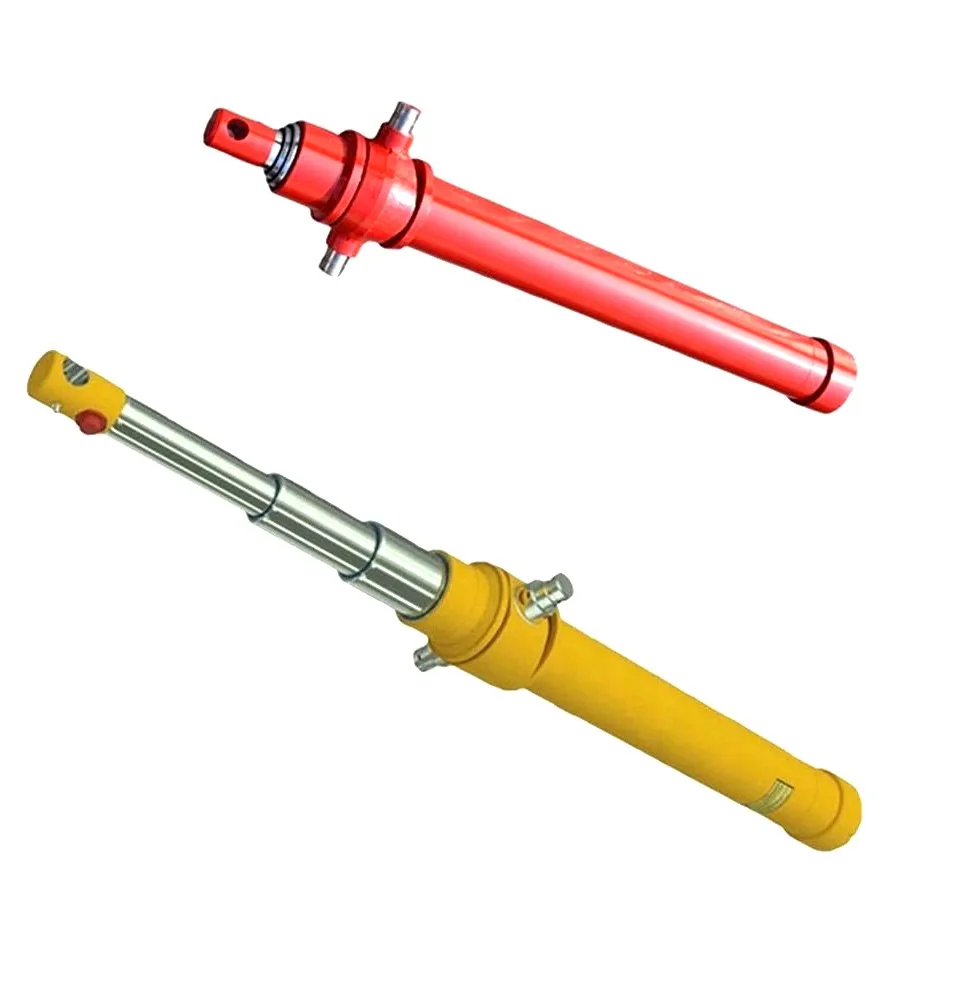
Let’s be blunt: a hydraulic cylinder is not just a force generator. On any stroke over 40 inches, it is a long-column compression member.
Most field engineers rely on the standard Euler Buckling Formula (Pcr = π2EI / L2) to decide if a rod will hold. They punch in the numbers, see a safety factor of 2.0, and sign off. Then, six months later, the rod bananas under load, the seals shred, and the machine goes down.
Euler didn't lie, but he assumed a perfect world. He assumed the load was perfectly axial, the material was perfectly homogenous, and the mounting was perfectly rigid. In the dirt and vibration of a construction site or a waste transfer station, "perfect" does not exist.
The theoretical length (LL) in your calculation is a variable, not a constant. It depends entirely on the K-factor (End Fixity Factor). This is where the first "lie" happens.
| Mounting Style | Theoretical K-Factor | HCIC Real-World Safety K-Factor |
|---|---|---|
| Fixed-Fixed (Both ends rigidly bolted) | 0.50 | 0.65 |
| Fixed-Pinned (One end bolted, one eye) | 0.70 | 0.85 |
| Pinned-Pinned (Clevis eyes at both ends) | 1.00 | 1.20 |
| Fixed-Free (Telescopic mast style) | 2.00 | 2.50 |
If you use a K-factor of 1.0 for a pinned-pinned dump trailer cylinder, you are ignoring pin-slop, bushing wear, and frame flex. At HCIC, we apply a "Shop-Floor Penalty" to K-factors. We assume a 20% margin of error in mounting alignment. That 20% difference in K-factor reduces your critical load by nearly 40%.
Buckling is rarely a sudden snap. It is a geometric runaway.
If your hydraulic cylinder is misaligned by just 3 to 5 degrees—common in agricultural or refuse equipment—the load is no longer axial. It creates a bending moment (M=P×eccentricity). As the rod starts to deflect, the eccentricity increases. The more it bends, the harder the load pushes it to bend further.
This is why we push for Stop Tubes on any stroke exceeding 10 times the rod diameter.
A stop tube is a simple internal spacer that prevents the piston from reaching the head-end gland. Why waste stroke length? To increase the distance between the piston bearing and the rod bearing.
This increased "bearing span" provides the lateral support needed to fight the bending moment. It doesn't stop the load from being off-center, but it stops the rod from having enough "room" to start the buckling arc. If your supplier isn't asking about your mounting precision, they aren't worried about your buckling limit.
Yield strength is the floor, but Modulus of Elasticity (EE) is the ceiling. For most steels, EE is roughly 29×10629×106 PSI. Whether you use expensive alloy steel or standard carbon steel, the initial resistance to bending is the same.
The advantage of high-tensile 4140 or QPQ-treated rods isn't that they won't bend—it's that they can bend further and return to straight without permanent plastic deformation. Once a rod hits its yield point during a buckle, it is scrap.
At HCIC, we don't just use a spreadsheet. For long-stroke telescopic or engineering cylinders, we run a non-linear buckling analysis that accounts for:
Every unit in our HTC and HSG lines is verified against these real-world penalties. We build for the 5-degree tilt and the worn pin, not the CAD drawing's perfect world.
If your stroke‑to‑rod‑ratio exceeds 10:1, or if your retracted pin‑to‑pin distance exceeds 40 inches. It adds cost, but it’s cheaper than a bent rod.
No. Buckling is a function of geometry (Moment of Inertia) and the Modulus of Elasticity. Higher strength only prevents permanent bending; it doesn't stop the buckling arc from starting.
QPQ doesn't change the buckling limit, but the nitrogen diffusion zone (0.3mm+) increases surface fatigue life, preventing the micro‑cracks that often initiate failure during a deflection event.
WhatsApp: +86 153 7619 8599
Email: davidsong@mail.huachen.cc
Website: http://jnhcic.com/