
In open-pit mining in Northern Canada, forestry harvesting across Scandinavia, aggregate hauling in the Northern United States, and oilfield operations in Alaska, heavy machinery routinely starts up in ambient temperatures between -30°C and 50°C (-22°F to 122°F).
Under these severe sub-zero thermal extremes, standard commercial hydraulic cylinders experience catastrophic failure rates during early morning startups.
Equipment operators frequently report three sudden failure modes:
1. Massive External Rod Weepage: Hydraulic Cylinders that held pressure perfectly in autumn begin streaming hydraulic oil down the piston rod within minutes of the first winter cold start.
2. Ice Ingestion & Scored Chrome Rods: Frozen ice sheets and hardened frost glaze on extending rods slice straight through standard elastomeric wipers, pulling abrasive ice crystals and road brine directly into the primary pressure seal gland.
3. Catastrophic Brittle Barrel Rupture: Thick-walled steel tubes that withstand 25 MPa in temperate weather suddenly crack lengthwise like glass when subjected to a sudden pressure spike on frozen ground.
Understanding why these failures occur requires examining the microscopic polymer physics of hydraulic seals and the ductile-to-brittle transition behavior of structural steel.
| Design Parameter | Standard Commercial Cylinder | Arctic Sub-Zero (-40°C to -50°C) |
|---|---|---|
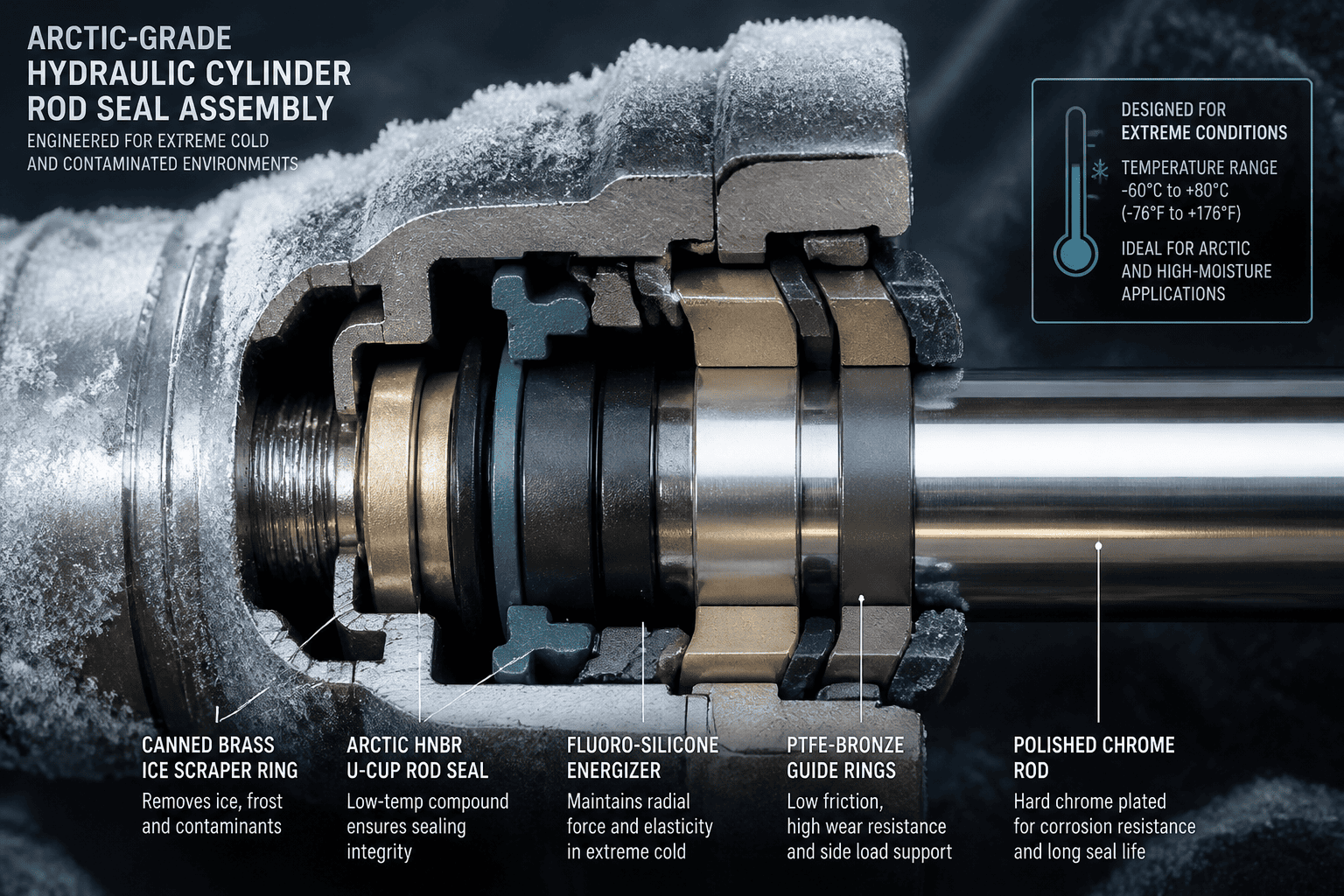
| Primary Rod Seal Material | Standard Cast Polyurethane | Low-Temp Arctic HNBR / Special PU |
| Polymer Glass Transition Temp (Tg) | Approx. -20°C to -25°C | Rated Down to -45°C to -55°C |
| Seal Energizer Type | Standard NBR O-Ring | Low-Temp Fluoro-Silicone Energizer |
| Rod Wiper / Scraper Profile | Single-Lip Soft Polyurethane | Dual-Lip Metallic Canned Scraper |
| Barrel Steel Grade & Toughness | Standard ST52 / Q355B | Normalized Q355D/E / 20MnV6 Alloy |
| Charpy V-Notch Impact Energy | Unrated at -40°C (< 15 J) | Certified ≥ 27 Joules at -40°C |
| Piston Rod Hard Chrome Thickness | 15–20 μm Single Chrome Layer | ≥ 25 μm Micro-Crack Nickel-Chrome |
| Piston Guide Ring Material | Standard Glass-Filled Nylon | Low-Moisture PTFE-Bronze Compound |
| Recommended Hydraulic Fluid | ISO VG 46 Anti-Wear Oil | ISO VG 15/22 Synthetic Arctic Oil |
Every polymer seal material possesses a fundamental physical property known as the Glass Transition Temperature (Tg). Above this temperature, elastomer polymer chains remain flexible, rubbery, and capable of expanding to maintain continuous radial pre-load against moving steel surfaces.
When ambient temperatures drop below the polymer’s typically around -20°C for standardpolyurethane and -25° C for general-purpose NBR nitrile), the polymer chains freeze into a rigid, glassy state. The material's elasticity drops precipitously, its durometer hardness spikes to near-plastic levels, and its coefficient of thermal contraction causes the seal to physically shrink away from the cylinder barrel and rod.
When pressurized hydraulic cylinder fluid hits the frozen seal during morning startup, the rigid lip cannot flex or conform to the microscopic surface finish of the moving rod, resulting in instantaneous, massive fluid bypass across the gland.
Most structural carbon steels exhibit a well-documented Ductile-to-Brittle Transition Temperature (DBTT). In warm conditions, steel absorbs shock loads through microscopic plastic deformation (ductility). However, at temperatures below -20°C, the crystalline lattice of standard un-normalized steel loses its ability to arrest microscopic stress cracks.
If an excavator bucket strikes frozen granite or a dump truck bed jolts over iced ruts, dynamic pressure spikes exceeding 30 MPa propagate through the frozen oil. In steel lacking certified sub-zero impact toughness, these pressure waves cause instant, brittle cleavage fracture along longitudinal weld seams or grain boundaries, causing the barrel to split open without prior warning.
[Cold Air Exposure (-40°C)] → [Elastomer Reaches Tg] → [Seal Shrinks & Hardens to Glass]
↓
[Hot Pump Fluid (+50°C) Inrush] → [Thermal Expansion Shock] → [Instant Morning Blow-By]
↓
[Ice Crystals on Rod Surface] → [Cracked Brittle Wiper] → [Scored Chrome & Ingested Sludge]
To eliminate the danger of brittle structural fracture, hydraulic cylinders designed for sub-zero operations must utilize specialized, fine-grain normalized micro-alloyed steels:
Designing a leak-free cylinder for -40°C service requires replacing standard catalog seals with an integrated Arctic-grade sealing system:
A common operational error in winter fleet maintenance is immediately placing hydraulic cylinder machinery under full load after starting the engine.
When engine-driven hydraulic pumps begin circulating warm fluid (+40°C to +60°C) into an un-extended cylinder whose thick steel barrel sits at -40°C, a severe thermal gradient develops. The inner surface of the barrel expands rapidly while the outer wall remains contracted, creating internal hoop stresses. Simultaneously, the piston and guide rings expand faster than the heavy-walled cylinder tube, reducing internal running clearances and causing piston galling or scoring.

1. Low-Pressure Circulation: Run the hydraulic pump at low engine idle for 10 to 15 minutes, allowing oil to circulate over the main relief valve to bring the system fluid up to at least 15°C.
2. Partial Stroke Cycling: Cycle all hydraulic cylinders through partial strokes at low pressure (no external load) for 3 to 5 full cycles to evenly distribute warm oil along the internal barrel walls and soften seal lips before applying heavy working loads.
3. Synthetic Arctic Fluid Selection: Utilize low-viscosity, high-viscosity-index (VI > 150) hydraulic oils such as ISO VG 15 or ISO VG 22 formulated with synthetic pour-point depressants to prevent pump cavitation.
Engineering mobile equipment, snow plows, heavy tippers, or forestry harvesters for cold-climate export markets?
Partner with HCIC. Our specialized cold-climate cylinder line features certified -40°C Charpy-tested alloy steel barrels, UK Hallite Arctic sealing packages, and automated micro-crack hard chrome plating engineered to withstand the harshest winter job sites.
Contact our engineering team at info@jnhcic.com or WhatsApp +86 153 7619 8599 to review your sub-zero application requirements and receive certified 3D CAD models and factory-direct quotations.