1.1 The Myth of the Naked Eye Let’s cut the fluff. Most fleet managers think if their hydraulic oil looks amber and clear, the system is safe. They are dead wrong. The real killers in the 2026 high-pressure market are particles between 2 and 5 microns—too small for the human eye to see, but perfectly sized to wedge into the clearance between your rod and the gland. At HCIC, we call this the "Silent Sandblaster." This micro-silt doesn't cause a catastrophic blowout; it causes a "soft-fail" where your cycle times slow down by 15% before you even notice a leak.
1.2 The Velocity Trigger Physics doesn't care about your maintenance schedule. When oil is forced through a small orifice or across a valve spool, it accelerates. These micro-particles hit your precision-honed surfaces at hundreds of feet per second. This is "Silt Abrasion." It physically scours the surface, destroying the mirror finish of your heavy duty hydraulic rams and turning your precision-machined ports into jagged, leaky bottlenecks.
2.1 Diagnosing the Micro-Scour How do you prove silt abrasion? Look for a "frosted" or matte finish on a rod that should be mirror-bright. Under a 50x lens, this isn't wear—it’s millions of microscopic impact craters. If your supplier is still using standard chrome plating without induction hardening, these craters become the "seeds" of rust. At HCIC, our company protocols focus on "Surface Density." We ensure the base metal is hard enough that the silt can't find a foothold to begin the scouring process.
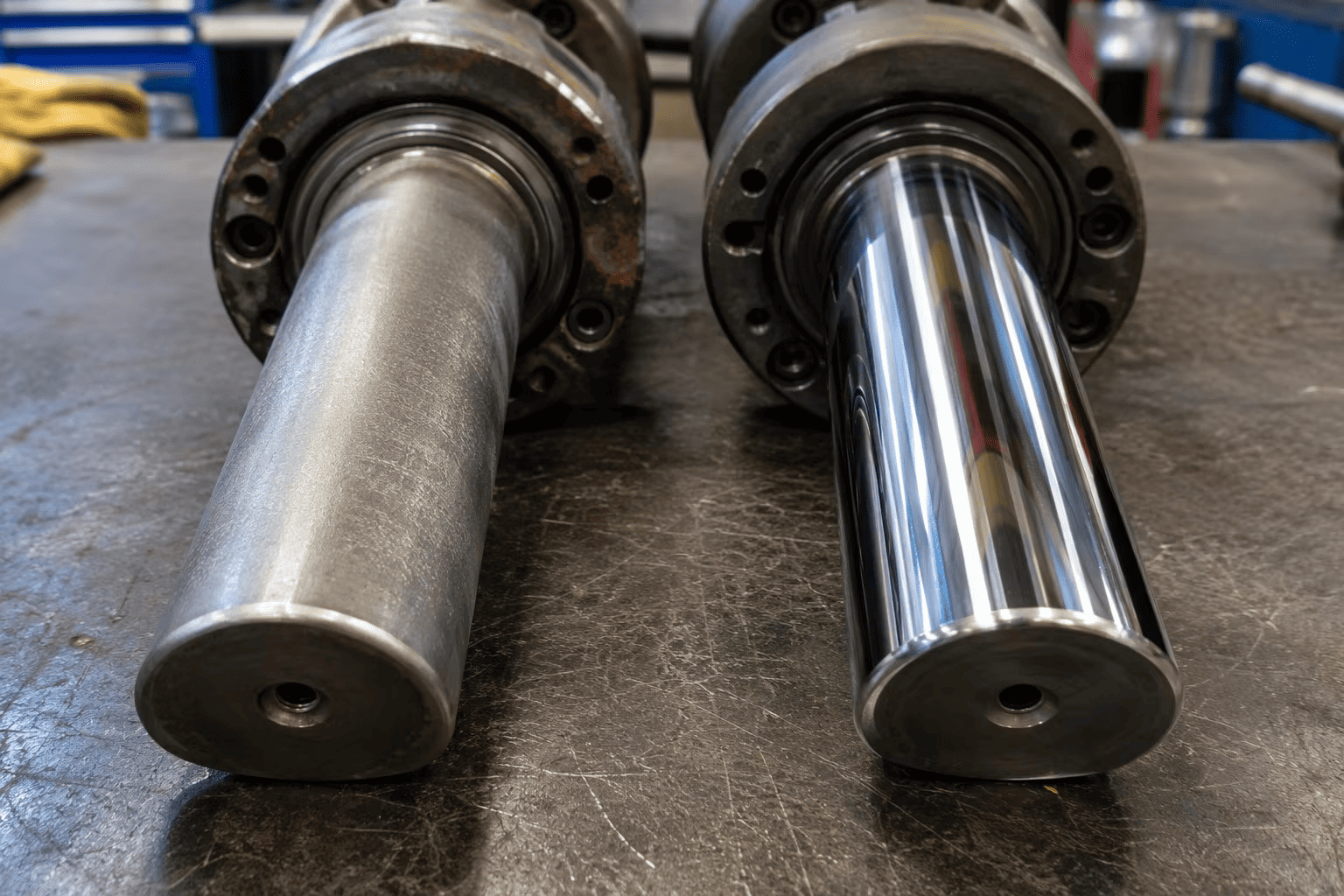
3.1 Engineering Against the Silt At HCIC, we don't just build cylinders; we engineer for contaminated reality.
The 2026 industrial landscape is too expensive for "soft-failures." If your equipment is losing its "bite" or moving sluggishly under load, don't just change the oil—audit your filtration and your cylinder specs. HCIC provides the metallurgical depth to build gear that fights back against silt. Ready to see the lab data on how our QPQ and hardened rods resist micro-scouring? Contact our engineering lead in Jinan for a technical review today.